Empowered Jurors are Guardians of Liberty Against Unjust Laws

Brady List
Potential Impeachment Disclosure [PID] Database
Transparency. Accountability. Due Process.
Explore public-facing accountability records and potential impeachment disclosures involving law enforcement officers, prosecutors, judges, and government agents.
Articles
A Juror’s Conscience
The Laura Kriho Contempt Case
In the annals of jury nullification, few cases are as controversial or instructive as that of Laura Kriho. In 1996, Kriho, a resident of Colorado, found herself at the center of a legal firestorm after serving on the jury for a drug possession trial. Her refusal to convict based on her moral objections to drug laws ignited debates about the role of jurors, the limits of judicial authority, and the principle of jury nullification.
Breaking the Chains of Injustice
Jury Nullification and the Fugitive Slave Act
In the mid-19th century, the Fugitive Slave Act of 1850 became one of the most contentious laws in American history, pitting federal authority against the conscience of free-state communities. As part of the Compromise of 1850, the Act required citizens and officials in free states to assist in the capture and return of escaped enslaved individuals. It imposed harsh penalties on anyone aiding fugitives or obstructing their capture, further entrenching the institution of slavery in American law.
Attorney Privilege
Ethical Restrictions on Nullification Arguments
Jury nullification is one of the most controversial yet essential aspects of the American legal system. It allows jurors to acquit a defendant, even in the face of clear evidence, if they believe the law is unjust or its application in the case is inappropriate. While jurors have the right to nullify, attorneys face stringent ethical restrictions that prevent them from openly advocating for nullification during trials.
Cheers to Defiance
Jury Nullification and Prohibition’s Legal Rebellion
The Prohibition era, spanning from 1920 to 1933, marked one of the most controversial periods in American legal history. Championed by temperance advocates, Prohibition sought to eliminate alcohol consumption to curb crime, domestic abuse, and other social issues. The result was the 18th Amendment, enforced through the Volstead Act, which banned the manufacture, sale, and distribution of alcohol nationwide.

Bureaucratic Expansion
The Influence on Jury Autonomy
The jury system has long been celebrated as a cornerstone of democracy, a mechanism through which ordinary citizens can serve as a check on governmental power. Yet, the growing bureaucratic complexity of the American justice system has steadily eroded this autonomy, diminishing the jury’s ability to act as an independent arbiter of justice. This bureaucratic expansion prioritizes efficiency, conformity, and control, often at the expense of fairness and community oversight.
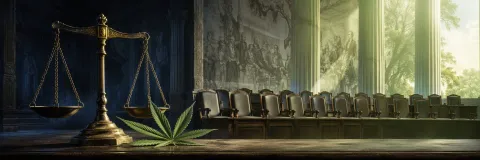
Cannabis & Conscience
Jury Nullification in Marijuana Cases
The story of marijuana legalization in the United States is one of gradual change, driven by shifting societal values and persistent activism. Yet, long before cannabis became legal for medical or recreational use in many states, jurors were quietly resisting the enforcement of harsh anti-cannabis laws. Through acts of jury nullification, they challenged the legality of punishing individuals for marijuana-related offenses, reflecting a growing discontent with the status quo.
Media Image